



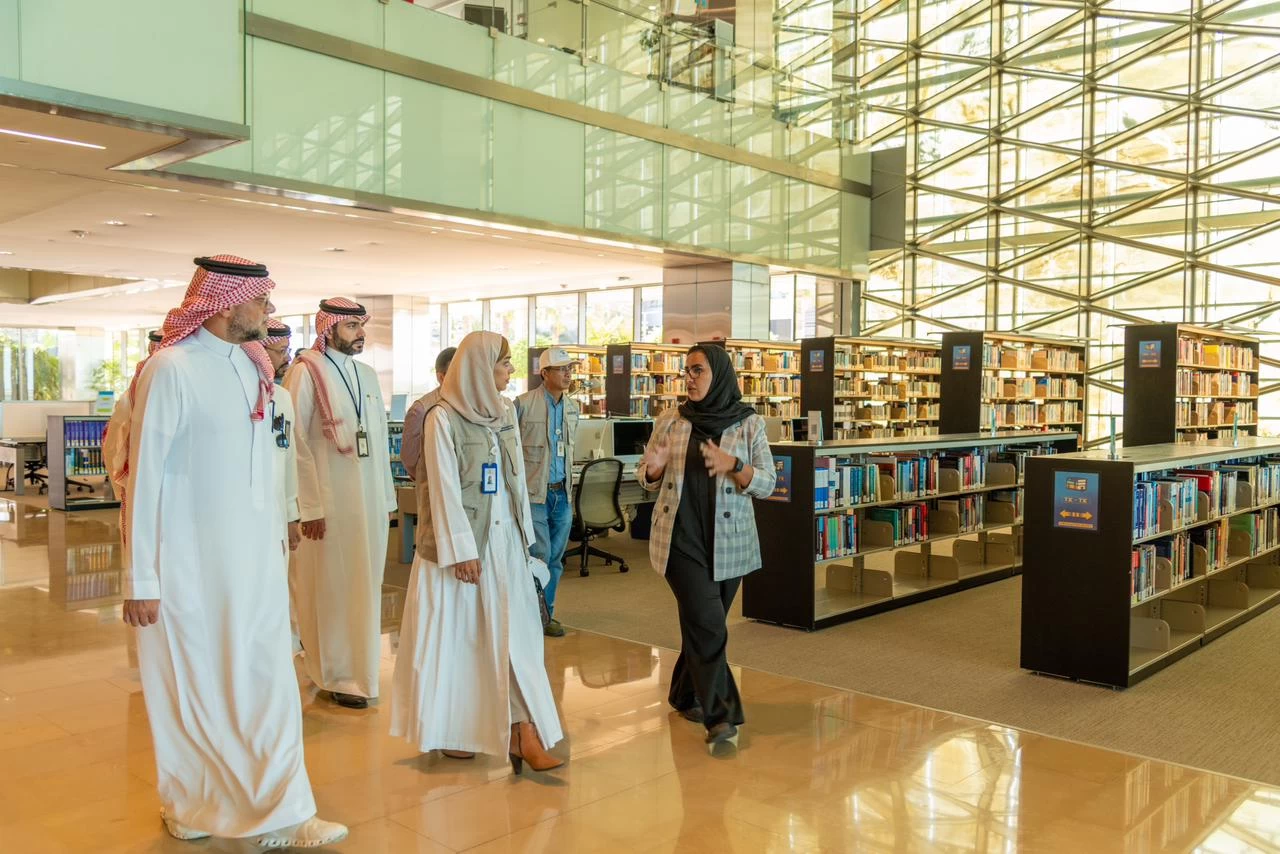
The SGS Department for Communications and Knowledge, headed by its Senior Director, Ms. Rana A. Zumai; the Head of the Editorial and Knowledge Section, Mr. Majed A. Ahmadi; the Head of Relationships and Ceremonies Section, Mr. Ehab H. Mamlouk, accompanied by the staff members of the communication and editorial units, visited the library and the document repository and archival sections of the King Abdullah University of Science and Technology (KAUST) on May 25, 2023. They were warmly welcomed by the KAUST Library officers and staff members. Mr. Mohammed Baessa, the manager of the Preservations and Digital Services unit, guided the SGS visitors through the KAUST library and presented a brief history of the library and its component systems, including its repository and archival management structures. Mr. Eamon Smallwood, the University Archivist, briefly discussed their archival system and also led the SGS visitors to a brief visit to the KAUST physical archive section.
This visit to the KAUST provides the SGS group an opportunity to observe what best practices in the repository and archival systems can be picked up from the KAUST system that can be employed at the SGS to enhance the existing SGS archival and repository system. Such an effort to strengthen the SGS material and digital archival system is both crucial and timely as the SGS has already embarked on vital national projects pursuant to its mandate and contributions to the Vision 2030 initiatives. The proceedings of these initiative projects and programs should be well-documented and preserved. Strengthening and enhancing the SGS archival system should be done at this opportune time in order to upgrade its archive to best serve both its in-house geoscientists and the external end users of these data and information, particularly the investors, academic researchers, students, and the development planners and policymakers of the government. The SGS revitalized system should be user-friendly and accessible to these end-users. Policies on who can access these data and documents, as well as the attendant digital archival infrastructure on how to request and access the data and documents, should also be upgraded to provide ease of use of the system to the end-users and to optimize the use of these SGS data and documents.
The SGS archive is not just a mass collection of scientific and historical data and documents. Scientific data serve important functions in national socioeconomic development, as they provide the bases for sound policies and the platform for propelling science-based development thrusts and actions. The SGS archive also serves as the chronicle of the SGS events and projects, thereby continuously building its historical institutional memory and its developmental milestones and contributions to Saudi Arabia’s nation-building and progress. Thus, these data and documents should not just be systematically stored but also be secured from alteration and preserved as part of the historical institutional wealth of the SGS. Further, as misinformation and disinformation become rampant, especially on the internet and other social media platforms, the SGS archive can also serve as the validating reference for accurate and empirical scientific data and information for both the present and future generations to rely on, when it comes to geoscience information reliability and veracity.
Publish Date: 31/May/2023
